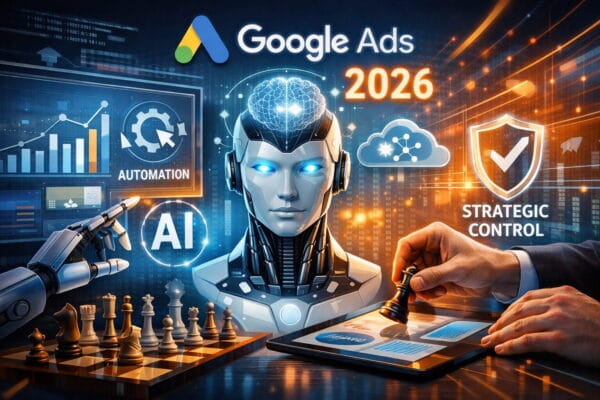
Key Advertising Trends in Google Ads in 2026: Automation, Artificial Intelligence, and Strategic Control Remain the Main Success Factors.
1. Introduction
A Brief Overview of the Role of Google Ads in Modern Marketing
Contextual Advertising in Google Ads today is one of the main tools of digital marketing, providing businesses with access to a global audience and precise targeting. Its role can be described through several key aspects:
Scalability and Reach
The platform covers billions of users across Search, YouTube, Gmail, and partner sites, allowing businesses to operate both locally and internationally.
Precise Targeting
Google Ads makes it possible to set up ads by keywords, interests, geography, and user behavior, making campaigns highly relevant.
Flexibility of Formats
From text ads in search to video on YouTube and interactive banners — businesses can choose the format that best suits their goals.
Transparent Analytics
Integration with Google Analytics and other tools allows tracking campaign effectiveness in real time and optimizing them for ROI.
Automation and AI
Modern campaigns increasingly rely on machine learning algorithms that optimize bids, audiences, and creatives, reducing manual work for marketers.
Thus, Google Ads in modern marketing is not just an advertising platform but an ecosystem for managing demand and conversions, combining reach, precision, and artificial intelligence technologies.
Understanding the modern role of advertising in Google Ads makes it possible to see how quickly the advertising ecosystem is changing. The next important step is realizing why 2026 has become a turning point for automation and AI advertising.
Why 2026 Is a Turning Point for Automation and AI Advertising
2026 can be considered a point of no return for advertising technologies, as automation and artificial intelligence are no longer “additional tools” but have become the central logic of Google Ads. There are several key reasons:
🔹 1. Mass Adoption of AI Campaigns
- Formats such as Performance Max have finally replaced classic manual campaigns.
- Algorithms independently determine optimal channels, audiences, and creatives, making AI the standard rather than an option.
🔹 2. Changing Role of the Marketer
- Whereas previously specialists manually managed bids and keywords, now they act as strategists and mentors for the algorithm.
- Human work shifts toward goal-setting, data preparation, and creative strategy.
🔹 3. Data as Fuel for Algorithms
- Google’s algorithms in 2026 operate almost exclusively based on conversion signals.
- Businesses without quality CRM and clean analytics effectively lose the ability to compete.
🔹 4. Rising Competition and Lead Costs
- Automation has become available to everyone, so competition for quality audiences has increased.
- This pushes companies to seek new differentiation strategies — through content, landing pages, and unique offers.
🔹 5. Integration with AI Search
- Google is actively transforming the search ecosystem by adding AI answers and generative search.
- This changes user behavior and forces brands to adapt ad messages and pages to new formats.
Thus, 2026 is the moment when automation becomes the norm, and strategy and data quality become the main competitive advantages.
Since automation has already become the norm, businesses need not just observe changes but actively adapt to new tools. The ability to quickly restructure determines competitiveness in 2026.
The Importance of Business Adaptation to New Tools
In 2026, adapting business to new tools in Google Ads becomes not just an advantage but a condition for survival in the market.
🔹 1. Competitiveness
Companies that quickly implement AI campaigns and automation gain access to higher-quality leads and reduce advertising costs. Those who remain with old methods risk losing positions.
🔹 2. Investment Efficiency
New tools allow budgets to be optimized in real time, automatically redistributing them among channels with the highest returns. This increases ROI and reduces the risk of wasted spend.
🔹 3. Flexibility and Scaling
Adapting to AI advertising opens opportunities for rapid campaign scaling without expanding the team. Businesses can operate simultaneously in multiple markets using automatic targeting settings.
🔹 4. Using Data as an Asset
CRM and analytics integration turns data into a strategic resource. The better a business works with data, the more accurately algorithms predict customer behavior and the more effective advertising becomes.
🔹 5. Building a Long-Term Strategy
Adapting to new tools allows businesses not only to react to changes but to shape their own development strategy. This creates a foundation for stable growth in the future.
👉 Thus, the importance of adaptation lies in transforming a business from a “user of advertising” into an active player in the digital ecosystem, managing data, strategy, and technology to achieve maximum impact.
Thus, it is no longer enough for businesses to simply launch advertising campaigns — they need to adapt to new tools and strategies. Next, we will analyze which specific trends in Google Ads will define success in 2026.
2. Automation and Artificial Intelligence
AI Campaigns as the Standard: Performance Max and Other Automated Formats
In 2026, automation has finally established itself as the foundation of advertising campaigns in Google Ads. Performance Max and other AI formats are no longer perceived as novelties — they have become the standard for businesses of all sizes.
🔹 Advertising in Performance Max — the Main Tool
- A single set of campaigns for all channels: Search, YouTube, Gmail, Display Network, Discover.
- Algorithms optimize the budget in real time, directing it where conversions are highest.
- Minimal manual work: the marketer sets goals, and the system itself selects audiences, creatives, and formats.
🔹 Other Automated Formats
- Dynamic Search Ads (DSA) — create ads based on website content.
- Smart Shopping — automatically optimizes product displays in Google Shopping and YouTube.
- Responsive Ads — combine headlines and descriptions to find the most effective option.
🔹 Benefits for Business
- Scaling without increasing the team.
- Rapid testing of different formats and audiences.
- Higher efficiency thanks to analyzing hundreds of signals in real time.
🔹 Challenges and Risks
- Less control: the marketer cannot manage every element.
- Dependence on data: the quality of CRM and analytics directly affects results.
- Need for strategic thinking: automation does not replace setting business goals.

Theoretical advantages of automated formats look convincing, but their true value is revealed in real business cases. Examples from different markets show how Performance Max and other AI campaigns work in practice and deliver tangible results.
Practical Examples of Using AI Advertising Campaigns in 2026
To demonstrate how advertising in Performance Max and other automated formats works in practice, here are several cases from different markets:
🔹 E-commerce in Ukraine
An electronics online store launched a Performance Max campaign to promote new smartphones.
- The algorithm automatically distributed the budget across Search, YouTube, and Gmail.
- The campaign generated personalized ads for different audience segments.
- Result: conversion growth of 28% and a 15% decrease in CPA compared to classic search campaigns.
🔹 B2B in the European Union
A company selling SaaS solutions for businesses used Performance Max advertising to generate leads.
- The algorithm targeted executives of medium and large businesses through LinkedIn partner platforms and YouTube.
- Using integrated CRM signals allowed AI to distinguish quality leads from irrelevant ones.
- Result: an increase in leads by 35% while maintaining the same budget.
🔹 Local Service in the USA
A network of dental clinics launched Smart Campaigns and Performance Max to attract clients in specific cities.
- The algorithm automatically displayed ads in Search and on Google Maps.
- Dynamic ads with addresses and reviews were used.
- Result: appointments increased by 40% within the first three months.
How Algorithms Replace Manual Optimization
In 2026, advertising campaigns in Google Ads increasingly operate on the principle of “teach the system — and it will do the rest”. Artificial intelligence algorithms have gradually replaced classic manual optimization, which just a few years ago was the standard for marketers.
🔹 Previously: Manual Optimization of Advertising Campaigns
- The marketer independently selected keywords.
- Set bids for each segment.
- Tested different ads and manually analyzed their effectiveness.
- Constantly adjusted campaigns, spending a lot of time on routine tasks.
🔹 Now: Algorithmic Optimization
- Automatic keyword selection: the system itself determines which queries convert best.
- Dynamic bid management: AI changes bids in real time depending on conversion probability.
- Data-driven creatives: Responsive Ads combine headlines and descriptions to find the most effective option.
- Signal-based audiences: algorithms consider hundreds of factors — from search history to on-site behavior.
🔹 Advantages of This Approach to Ad Setup
- Speed: optimization happens instantly, without delays.
- Scalability: campaigns can be launched simultaneously in multiple markets without extra resources.
- Accuracy: algorithms account for more signals than a human can analyze manually.
Examples of Businesses Scaling Advertising Thanks to AI
🔹 E-commerce (Online Retail)
- Electronics stores and fashion brands use Performance Max advertising for personalized offers.
- Algorithms automatically distribute the budget across Search, YouTube, and Gmail.
- Result: up to +30–35% ROI growth during the year thanks to smart bidding and creative automation.
🔹 B2B Companies
- In 2026, Performance Max has gradually been adapted for the B2B segment.
- Companies selling SaaS solutions integrate CRM signals to distinguish quality leads from irrelevant ones.
- Result: lead growth of +25–35% with the same budget, especially in major European markets.
🔹 Local Services
- Networks of clinics, restaurants, and service companies apply Smart Campaigns and Performance Max for targeting in specific cities.
- Dynamic ads with addresses, reviews, and Google Maps are used.
- Result: bookings or appointments increased by +40% within the first months.
🔹 Global Brands
- Large DTC companies (direct-to-consumer) scale advertising through combining creative automation, smart bidding, and cross-channel feeds.
- This allows them to operate simultaneously in multiple markets without expanding marketing teams.
- Result: up to +35% measurable ROI growth during the year.
⚠️ Business Challenges
- Dependence on data: without quality CRM and analytics, AI performs worse.
- Less manual control: the marketer becomes a strategist rather than an operator.
- Increased competition: automation is available to everyone, so differentiation through content and value propositions becomes critical.
Thus, examples show that AI advertising has already proven its effectiveness in scaling businesses. From e-commerce to B2B and local services — Performance Max and other automated formats have become key growth tools in 2026.
| Business Segment | AI Campaign Format | Main Algorithm Actions | Results in 2026 | Key Challenges |
|---|---|---|---|---|
| E-commerce | Performance Max, Smart Shopping | Automatic budget distribution across Search, YouTube, Gmail | +30–35% ROI, -15% CPA | Dependence on high-quality product data |
| B2B (SaaS, Services) | Performance Max + CRM Integration | Selection of quality leads through CRM signals | +25–35% leads with the same budget | Complexity in data setup |
| Local Services | Smart Campaigns, Responsive Ads | Automatic display in Search and Google Maps | +40% appointments/bookings | Limited control over creatives |
| Global Brands | Performance Max + cross-channel feeds | Scaling advertising across multiple markets simultaneously | +35% ROI growth | High competition, need for differentiation |
3. Control over Automation
Automation of advertising campaigns in Google Ads in 2026 has become the standard, but this does not mean that businesses have lost the ability to influence results. On the contrary, new tools have emerged that allow maintaining a balance between algorithmic optimization and manual management.
New Tools for Targeting and Budget Settings
- Advanced audience parameters: marketers can provide more precise signals for AI, such as CRM integration or proprietary data.
- Flexible budget management: the system allows setting priorities for different segments to avoid wasting funds on irrelevant audiences.
- Integration with business goals: advertisers can define KPIs (e.g., lead quality or average order value), and the algorithm optimizes campaigns for these metrics.
Balancing Automation and Manual Management
- Automation handles routine tasks: bids, keywords, creatives.
- The marketer defines strategic goals, prepares quality data, and directs AI’s work.
- This balance helps avoid situations where the algorithm runs “blindly” without considering business realities.
Risks of Losing Control and How to Avoid Them
- Risk: the algorithm may optimize campaigns for cheap clicks but poor-quality leads.
- Solution: integrate CRM signals so the system accounts only for valuable conversions.
- Risk: excessive automation reduces process transparency.
- Solution: use reports and analytics tools to verify AI performance.
- Risk: businesses lose uniqueness if they rely entirely on algorithms.
- Solution: create unique creatives and value propositions that differentiate the brand.
Thus, control over automation in 2026 is not a return to manual optimization but rather the ability to properly configure algorithms and feed them with quality data. The marketer becomes a strategist who sets the direction, while AI performs the technical work.
However, even the most advanced automation tools cannot work effectively without quality data. Data becomes the foundation for algorithmic decision-making, determining targeting accuracy and conversion levels. Therefore, the next key aspect is examining the role of data as the cornerstone of advertising campaign efficiency.
4. Data as the Foundation of Efficiency
In 2026, data has become the main resource for successful advertising campaigns in Google Ads. Automation algorithms work only as well as the quality of the data they receive. Therefore, clean, structured, and integrated data is the foundation of efficiency.
Why Clean and Structured Data Is Critically Important
- Algorithms make decisions based on signals, and any “noisy” or incorrect data reduces targeting accuracy.
- Incomplete or duplicated data in CRM leads to inaccurate forecasts and wasted budget.
- Structured data allows the system to quickly identify valuable audiences and optimize bids.
Integration of CRM and Analytics
- CRM systems transmit information to Google Ads about lead quality, repeat purchases, and average order value.
- Google Analytics 4 provides a link between user behavior on the site and campaign results.
- Integration enables algorithms to optimize advertising not just for clicks but for real business outcomes.
Examples of Conversion Signals That Most Influence Algorithms
- Form submission (leads for B2B).
- Product purchase (key signal for e-commerce).
- Adding a product to the cart (strong indicator of purchase intent).
- Phone call or appointment booking (important for local services).
- Repeat purchase or subscription (critical for SaaS and DTC businesses).
Comparison Table
| Conversion Signal Type | Usage Example | Impact on Algorithms | Most Relevant Segments |
|---|---|---|---|
| Form submission | Contact form on a B2B website | Determines lead quality, helps AI distinguish relevant clients | B2B, Services |
| Product purchase | Checkout in the shopping cart | Strongest signal for sales optimization | E-commerce, DTC |
| Adding product to cart | Click “Add to cart” | Indicates high purchase intent, AI strengthens remarketing | E-commerce |
| Phone call / appointment booking | Click on phone number or online booking | Strong signal for local services, optimization for offline visits | Local businesses, clinics, restaurants |
| Repeat purchase / subscription | SaaS subscription renewal or repeat order | AI focuses on long-term customer value (LTV) | SaaS, DTC, E-commerce |
However, even the cleanest and most structured data cannot independently determine the direction of business development. Algorithms can optimize campaigns, but it is the marketer’s strategic vision that sets goals and priorities. Therefore, the next key aspect is examining the role of human strategy in a world of machine optimization.
5. Human Strategy in Ad Setup vs Machine Optimization
In 2026, automation of advertising campaigns in Google Ads has reached a level where algorithms can independently manage bids, targeting, and creatives. However, this does not mean that the role of the marketer disappears. On the contrary, human strategy becomes the defining factor of success, as it sets the direction for machine optimization.
The Role of the Marketer in Defining Business Goals
- Algorithms optimize campaigns only for the goals they are given.
- The marketer decides what is more important: sales, leads, repeat purchases, or increasing LTV.
- Without clear goal-setting, AI may work technically well but not strategically for the business.
How Strategic Thinking Guides AI
- Choosing KPIs: the marketer decides whether to optimize the campaign for lead quantity or quality.
- Audience Prioritization: humans determine which customer segments are key for the business.
- Creative Strategy: AI can combine headlines, but only the marketer creates a unique value proposition.
Cases Where Human Vision Outperforms Automation
- E-commerce: the algorithm optimizes for cheap clicks, but the marketer shifts strategy to increasing average order value, resulting in higher profits.
- B2B: AI generates many leads, but the marketer integrates CRM and filters out irrelevant contacts, focusing on quality clients.
- Local Services: the algorithm promotes generic ads, while the marketer adds unique messages (e.g., “appointments available today without waiting”), boosting conversion.
Thus, in the world of AI advertising, the marketer transforms from a “campaign operator” into a strategist and architect of business goals. The machine performs optimization, but it is the human who determines where it should lead the business.
6. New Requirements for Landing Pages
Landing pages in 2026 are no longer just a page with a “Buy” or “Submit Application” button. They are places where the user must feel that their needs are understood from the very first second. If previously a nice image and headline were enough, now that is insufficient — people expect interactivity, and Google’s algorithms demand clear structure.
A Landing Page Must Engage
Dry text and a basic form no longer work.
- Calculators, interactive blocks, videos — all of these keep users on the page longer.
- Google tracks how users interact: scrolling, clicking, watching. The more actions, the higher the chance of conversion.
- A landing page should feel like a dialogue, not a static advertisement.
Value Proposition Without Fluff
A user opens the page and decides within 3 seconds whether to stay or leave.
- The headline must immediately answer their questions: “What is this?”, “Why do I need it?”, “What will I get?”
- The first screen is the battlefield. If it doesn’t show a clear benefit, the user will simply close the tab.
- AI search algorithms also dislike vague wording — they extract only clear messages.
SEO and AI Search Dictate Structure
Now it’s important not just to “insert keywords” but to make the page understandable for the algorithm.
- Content must be divided into blocks: headings, lists, bullet points.
- AI reads meaning, not just phrases. If the structure is chaotic, the page won’t appear in search results.
- Therefore, a landing page should look like a well-organized document, where each block answers a specific user question.
A modern landing page is no longer design for design’s sake. It is an instrument that speaks simultaneously to humans and algorithms. It must be lively, interactive, and strategically thought out.
| Old Landing Page | New Landing Page (2026) |
|---|---|
| Simple page with a form and “Buy” button | Interactive hub: calculators, videos, configurators, interactive blocks |
| Headline without clear benefit, lots of fluff | Instant value message: specific offer and benefit on the first screen |
| Keywords inserted “just for show” | Semantic structure understandable for AI search: blocks, lists, bullet points |
| Design for the sake of visuals, without logic | UX + SEO + AI optimization, strategically designed structure |
| User quickly closes the page | Engagement through interactivity, clear messages, and dynamic content |
7. Challenges and Risks
AI advertising opens up huge opportunities but at the same time presents businesses with new challenges. In 2026, it is already clear that those who do not adapt quickly lose their positions.
Rising CPA for Those Who Do Not Adapt
- Algorithms optimize campaigns based on quality data. If a business does not update its strategy, the cost per acquisition (CPA) increases.
- Old targeting methods no longer work — advertising becomes more expensive and less effective.
Dependence on Data Quality
- AI works only as well as the quality of the data it receives.
- If CRM is “cluttered” with duplicates or incorrect leads, the algorithm optimizes campaigns incorrectly.
- Clean, structured data is now not just an advantage but a critical condition for survival.
Losing Competitive Advantage When Using Old Methods
- Businesses that still rely on manual optimization or “keywords for show” lose to competitors.
- AI search algorithms favor structured, interactive, and clear landing pages.
- Those who do not change remain invisible to modern users and search engines.
In 2026, the main risk is becoming an “old” business in a world of new algorithms. Those who do not adapt pay more, get less, and gradually disappear from the market.
8. Recommendations for Business
In short — in 2026, it is no longer enough for businesses to simply “launch ads.” Algorithms have become smarter, competition tougher, and users more demanding. Therefore, action must be comprehensive.
The first investment should be in analytics and CRM. Without quality data, AI works blindly. If your customer base is chaotic, with duplicates or incomplete contacts, advertising will waste the budget. But when CRM is integrated with analytics and everything is structured, algorithms begin to optimize campaigns for real business outcomes: lead quality, repeat purchases, long-term customer value.
Second — experiments with campaign formats. Performance Max, video ads, interactive formats — these are no longer “extras” but the standard. The algorithm learns better when you provide multiple entry points for customers. Therefore, testing and A/B experiments must be ongoing, not one-off.
Third — landing pages. Old pages with a “Buy” button no longer work. A modern landing page is an interactive space: calculators, videos, configurators, a clear value message on the first screen. It must be understandable both for humans and for AI search, which extracts structured blocks.
Finally — strategists. The algorithm can optimize bids and targeting, but it does not know what matters most to you: lead quantity or quality, quick sales or long-term loyalty. That is decided by humans. Therefore, the role of the marketer has changed: they no longer “tweak campaigns” but set the direction, while AI executes.
👉 To summarize: businesses need to invest in data, experiment with new formats, build rich landing pages, and have strategists who guide algorithms. Only then does advertising stop being an expense and become a real growth driver.
“Recommendations vs Results”
| Recommendation | What It Gives the Business |
|---|---|
| Investment in analytics and CRM | Clean data, proper customer segmentation, lower CPA, more accurate campaign optimization |
| Testing new campaign formats | More entry points for customers, faster algorithm learning, higher ad effectiveness |
| Developing rich landing pages | User engagement through interactivity, clear value message, better visibility in AI search |
| Engaging strategists to manage AI | Proper business goal setting, balance between lead quantity and quality, long-term competitive advantage |
“Risks vs How to Avoid Them”
| Risk | How to Avoid |
|---|---|
| Rising CPA for those who do not adapt | Update strategy, integrate CRM and analytics, optimize campaigns based on quality data |
| Dependence on data quality | Regularly clean the database, avoid duplicates, set up automatic data validation in CRM |
| Losing competitive advantage when using old methods | Test new campaign formats, create interactive landing pages, work with AI search |
| Algorithms working “blindly” without strategic vision | Engage marketing strategists who set business goals and guide AI |
9. Conclusion
In this article, we traced the path from how algorithms gradually replace manual optimization to new landing page requirements and the marketer’s role as a strategist. The main trends are clear: automation, dependence on data, interactivity, and strategic thinking.
In the coming years, this trend will only intensify. Algorithms will become even more precise, AI search will increasingly influence content structure, and competition will grow. Businesses that invest today in analytics, CRM, new campaign formats, and rich landing pages will gain an advantage. Those who stick with old methods risk paying more and getting less.
The call to action is simple: adapt now. Do not wait until the market changes completely — start restructuring today to be among those who set the rules tomorrow, not those chasing competitors.