The Search Revolution That’s Hard to Miss
Just a couple of years ago, the user’s path online was linear: type a query into Google, open the top‑3 sites, find what you need. Today, more often instead of the search bar, people open a chat window with ChatGPT, Gemini, or Perplexity.
Artificial intelligence delivers a ready, compiled answer in one click. For the user, it’s convenient. For business — it’s a challenge. If AI takes the clicks for itself, how can websites get traffic?
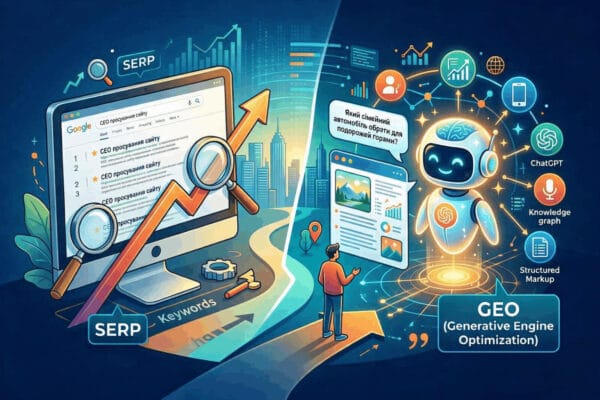
The answer to this challenge has become a new direction in marketing — GEO (Generative Engine Optimization), or optimization for generative engines.
What is GEO and How Does AI Choose “Favorite” Sites?
GEO is a set of actions aimed at ensuring that artificial intelligence mentions your brand, product, or article in its answers and provides a link to your site as the original source.
When an AI assistant generates a response, it doesn’t invent facts out of thin air (otherwise it’s hallucination). It scans the index, finds the most authoritative sources, and constructs a conclusion. To get into this “summary” of artificial intelligence, your content must meet three main criteria:
- Deep Expertise (E‑E‑A‑T): AI trusts authors with real experience, numbers, case studies, and proven reputation.
- Contextual Accuracy: The text must clearly and without “fluff” answer users’ intent‑based queries.
- Technical Perfection: AI bots must instantly read your site’s structure.
| Comparison Criterion | Classic SEO (Search Engine Optimization) | Modern GEO (Generative Engine Optimization) |
|---|---|---|
| Main Goal | Bring the site into the Top‑3/Top‑10 of Google’s regular search results. | Appear in the AI‑generated answer (ChatGPT, Gemini) as the original source. |
| Who Analyzes the Site | Search engine crawlers (e.g., Googlebot). | Large language models (LLMs) and their integrated AI assistants. |
| Semantic Focus | Keywords, exact and diluted entries, LSI words. | Conversational queries, long phrases (Long‑tail), contextual entities. |
| Site Response Format | A page with clear structure, lists, and meta tags. | Content with a high level of unique expertise, facts, and figures. |
| Source of Authority | Volume and quality of backlink profile, anchors. | Brand mentions in authoritative media, citations, and reviews on platforms. |
| Final Result | The user clicks the link and visits your site. | AI generates a conclusion and adds a link to your site for detailed exploration. |
Why Classic SEO is Still the Foundation?
The secret is that GEO doesn’t replace traditional promotion but logically follows from it. Artificial intelligence learns from the same index as regular search crawlers. If a site has a poor mobile version, no microdata, and pages load in 5 seconds — AI will simply ignore it.
That’s why quality SEO promotion of a website remains the basic foundation. Without clear technical optimization, optimal semantic structure, and proper internal linking, it’s impossible to build any future strategy. Only by closing the technical gaps of classic search can you move on to conquering AI search results.
3 Steps to Prepare Your Site for the AI Search Era
- Implement Advanced Schema Markup: Help bots recognize entities. Mark articles, authors, products, FAQ. The clearer the data structure for the code, the easier AI can structure it.
- Write for People, Considering Conversational Semantics: Users phrase queries to AI as if to a real interlocutor (“Which family car should I choose for mountain trips?”). Optimize content for long‑tail queries and conversational style.
- Work on Brand Citability: AI analyzes mentions on authoritative external resources, forums, media, and reviews. The more often your brand is mentioned positively, the higher the chance Gemini or ChatGPT will recommend you.
Conclusion
The era of generative search has already arrived. GEO is not a trend but a new logic of brand visibility in a world where answers are shaped by artificial intelligence. Those who adapt first will gain an advantage in the search results of the future.